
How do cells divide correctly?
Did you know your body’s cells divide billions of times every day?
Each time this happens, your cells must copy all their DNA (your genetic instructions) and split it evenly between two new cells. If something goes wrong during this process, it can lead to serious problems—like cancer in adults, or birth defects and miscarriages during early development.
So how does your body pull off such a complex task?
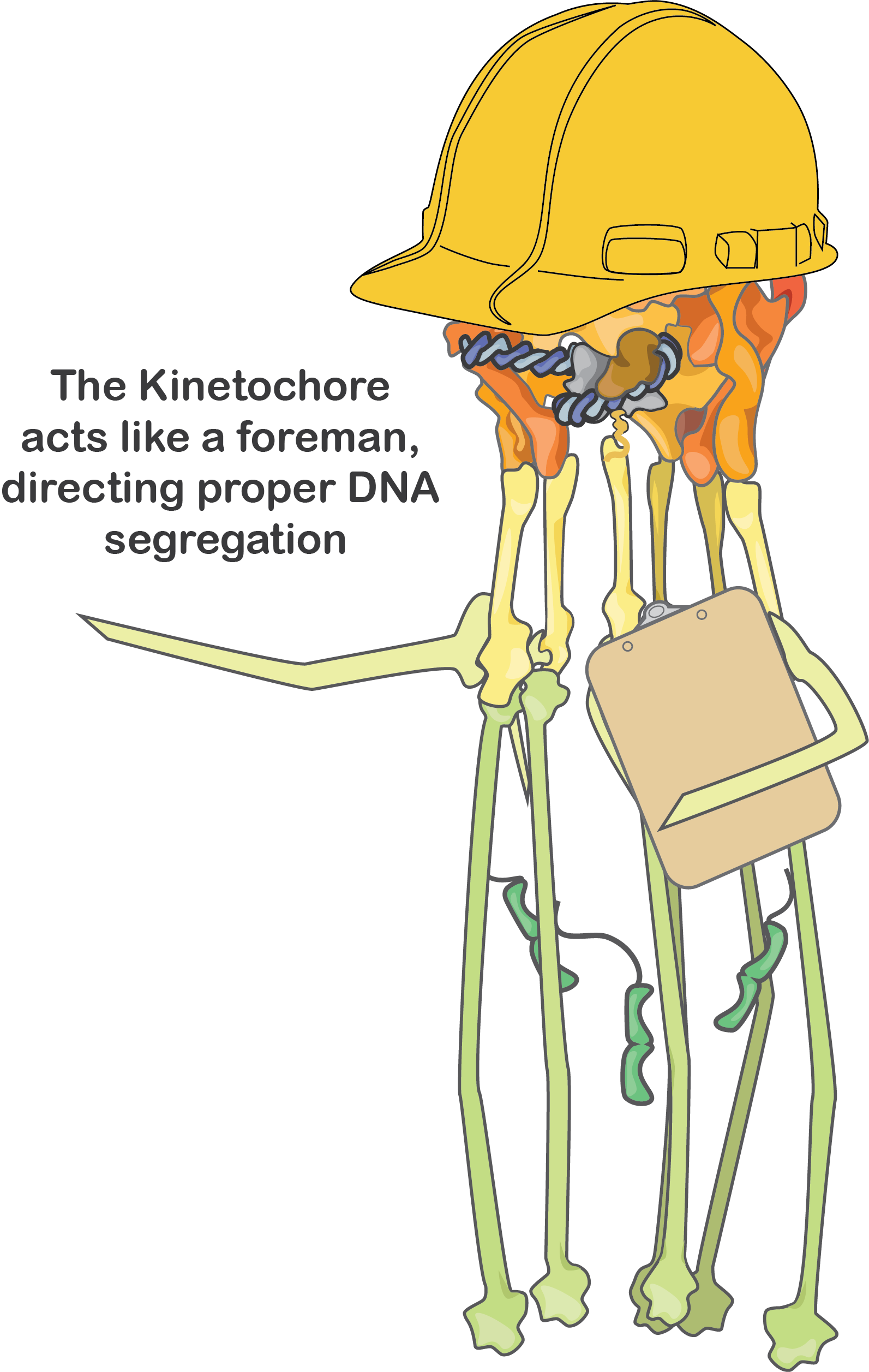
Meet the kinetochore — a tiny but mighty structure inside your cells that acts as a foreman! Its job is to grab onto chromosomes (your packaged DNA) and attach them to microscopic “ropes” called microtubules. These ropes help pull the chromosomes apart, making sure each new cell gets the right set.
What’s really amazing is that the kinetochore doesn’t just hold on — it can grip microtubules even while they’re moving, and detect when something isn’t right. If it senses a problem, it sends out signals that tell the cell to pause division until everything is sorted out. It's almost as if this collection of proteins is making decisions! But of course, proteins can't think — so how does a non-living molecular machine know when to hold on, let go, or signal for help? Answering that question is at the heart of our research.
How We Study It
Our lab uses a wide range of tools to understand how this system works — both inside living cells and outside living cells using purified components.
Inside cells, we figure out how the system works by breaking it in carefully controlled ways. We use genetic tools to change or disable specific parts of proteins and watch what goes wrong. Just as a mechanic can learn what a car part does by seeing what happens when it fails, we can discover the role of individual parts of proteins by observing how cells respond when they're altered.
Outside cells, we recreate this process in test tubes using purified parts. This approach, called in vitro reconstitution, lets us study each component of the kinetochore one piece at a time — like taking apart a car engine to understand how each part contributes to making the whole machine run.
By combining these two approaches, we get a clearer picture of how cells divide accurately — and what goes wrong when they don’t. And because these systems are so highly conserved, what we learn in the lab could help us understand (and maybe one day fix) problems in humans too!